How this story was pieced together
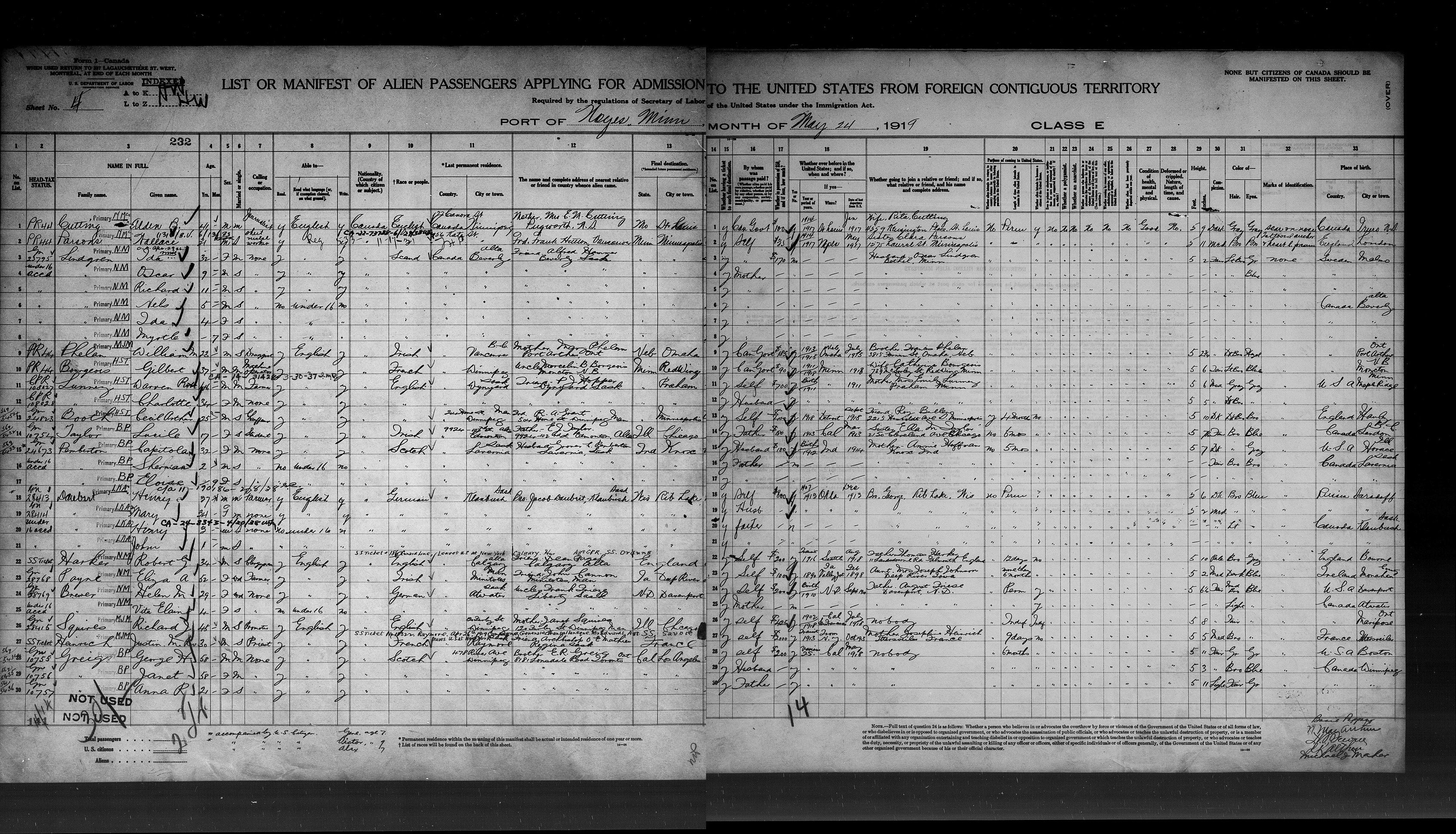
This story draws on two sources: Uncle Dick’s memories of the move, from the end of Chapter Two of his memoir, and a document he never saw — the United States immigration record made the day his family crossed the border. The two agree on almost everything. Where they don’t, we say so.On May 24, 1919, a train coming down from Winnipeg stopped at the little border station of Noyes, Minnesota, and a United States immigration inspector climbed aboard. Among the passengers he questioned was a 32-year-old Swedish woman travelling with five children, the youngest a baby of seven months. He wrote each of them onto a large printed form, line by line. That form survives, and it is the closest thing we have to a snapshot of the Lindgren family on the day they became Americans-to-be.
Leaving Canada
The family had spent seven hard years in Alberta — in Beverly, in lumber camps, and on tenant farms near Rabbit Hill — before settling back in Edmonton in 1918. They had just come through the Spanish flu together, every one of them, including newborn Myrtle. Then, as Dick remembered it:
“In winter of 1918 my father decided to leave Canada and immigrate to the United States. He was in communication with someone in Minneapolis, Minnesota. He had gotten in touch with a contractor that needed bricklayers, and he left for there in the spring of 1919.” — Richard Lindgren
Once again Oskar went ahead and found work first, and once again Ida was left to bring the children after him. This time there were five of them: Richard, 11; Oscar, 9; the two Canadian-born children, a boy of five and a girl of four; and baby Myrtle.
The journey south
Dick remembered the route clearly. “We took the railroad train east to Winnipeg, Manitoba then changed to a train bound south to the United States … and continue to Minneapolis. We were met on the train by an immigration agent who checked to find out where we were going and why we were going there. We cleared customs without any problems.”
That immigration agent left behind the record below. It is a two-page form, a “List or Manifest of Alien Passengers Applying for Admission to the United States from Foreign Contiguous Territory,” and the Lindgrens fill lines 3 through 8. The left page gives names, ages and where they came from; the right page continues across the same lines with who paid the fare, who they were joining, a physical description, and where each was born.
What the record tells us
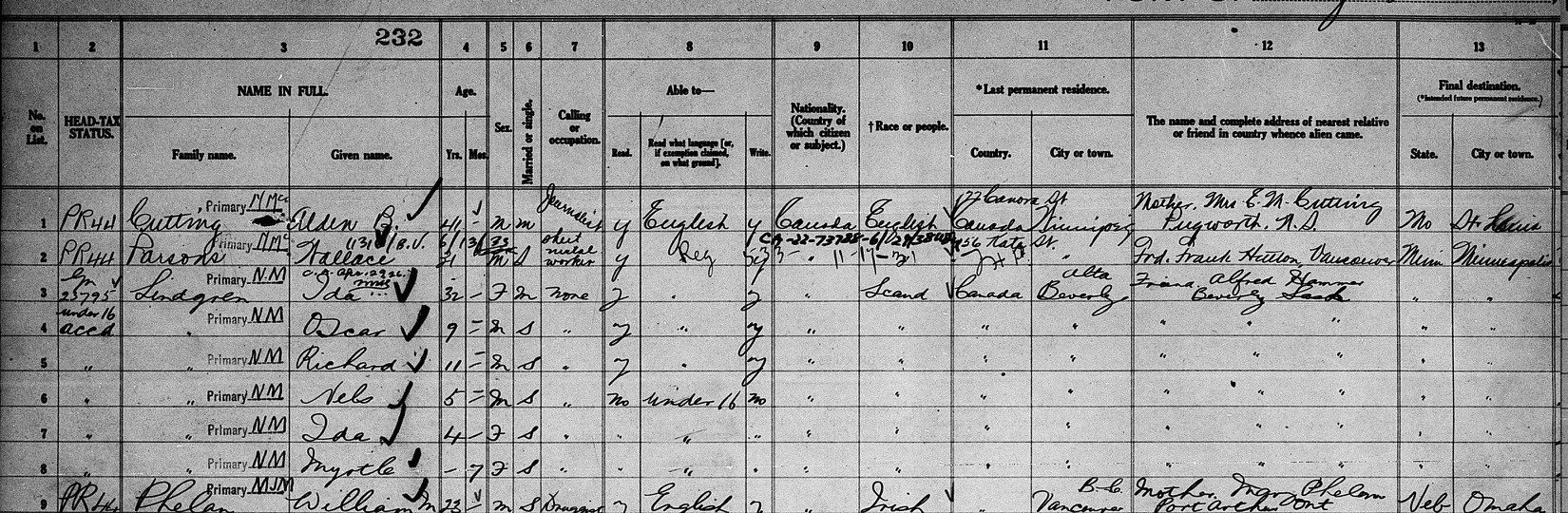
Reading across the lines, the inspector recorded:
- Ida Lindgren, 32, married, no occupation outside the home. Able to read and write. Race or people: “Scand” (Scandinavian). Last permanent home: Beverly, Alberta. Born in Malmö, Sweden.
- Oscar, 9, and Richard, 11 — both able to read and write, both born in Malmö. Richard had turned eleven just one week earlier.
- Nels, 5, Ida, 4, and Myrtle, 7 months — all three born in Beverly, Alberta.
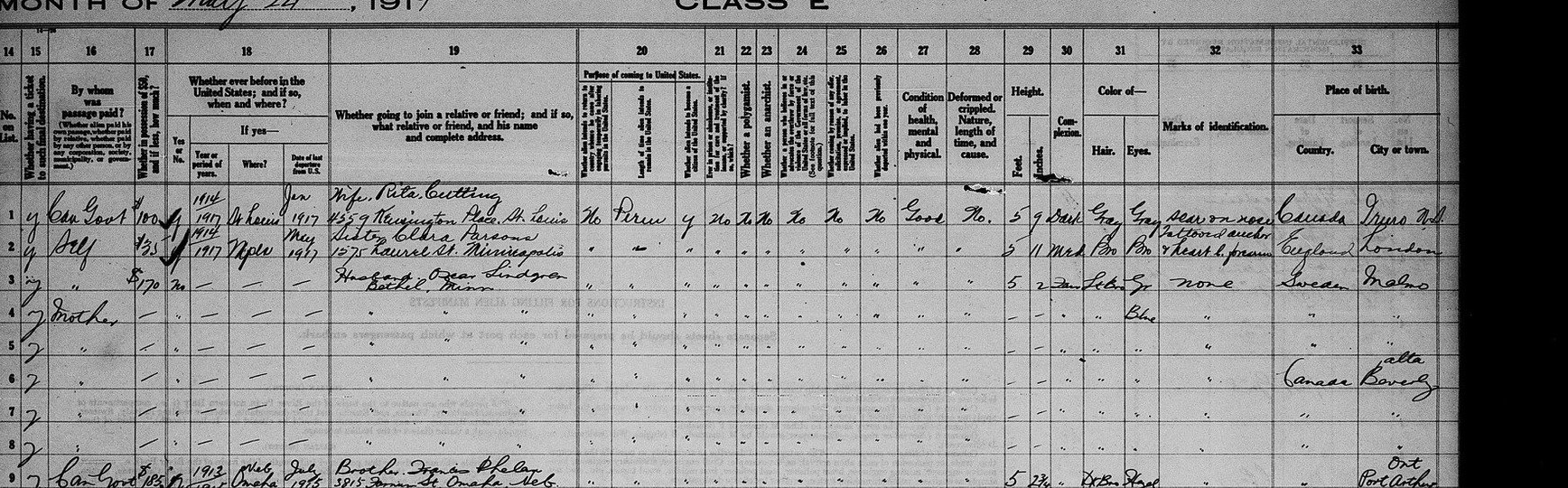
The right-hand page adds the rest. Ida paid the family’s passage herself and was carrying $170. None of them had ever been to the United States before. She was going to join her husband, Oscar Lindgren, of Bethel, Minnesota. The inspector described her as five feet two inches tall, with a fair complexion, light brown hair and gray eyes, and no identifying marks. Her boy Oscar had blue eyes. For each child, in the column “By whom was passage paid?”, he wrote simply: Mother.
On line 3, as the “nearest relative or friend in the country whence alien came,” Ida named a friend, Alfred Hammar of Beverly — someone the family evidently trusted to stay in touch with after they left.
Where the record and the memoir differ
- The border crossing. Dick remembered passing through International Falls. The record was made at Noyes, Minnesota, across the line from Emerson, Manitoba, which is where the main railway from Winnipeg to the Twin Cities entered the United States. It’s an easy mix-up to make decades later, as both are Minnesota border towns, but the paper settles it.
- The season. Dick wrote that they left “later that summer.” The record shows they crossed in late May, only weeks after Oskar had gone ahead.
- Bethel or Minneapolis? Dick remembered meeting his father in Minneapolis and living near the Mississippi. The record gives Oskar’s address as Bethel, a small town about thirty-five miles north of the city. Perhaps that was where his first job was, before the family found a house in town.
- “Nels.” The five-year-old boy on line 6 is listed as Nels. The family knew him as Art (Arthur). Dick’s handwritten Saga of the Lindgrens gives Art’s birthday as April 22, 1914, in Beverly, which makes him exactly five on the day of the crossing. Nils was the name of Ida’s father, Nils Malmberg, so Nels may well have been Art’s first given name.
A remarkable woman
Looking back, Dick couldn’t help comparing this trip with the one his mother had made seven years earlier, alone with two small boys and no English, all the way from Malmö to Edmonton:
“Now, in 1919, she brought five children from Edmonton to Minneapolis a trip of 1200 miles. She was a remarkable woman, our mother.” — Richard Lindgren
A new life in Minneapolis
Oskar had rented a house near the Mississippi River, between Minneapolis and St. Paul. That September Richard and Oscar started at a big city school, which took some getting used to after years of one-room prairie schoolhouses. They were no longer in the same room with the same teacher, and Dick admitted they felt their new friendships were “temporary.” But they quickly learned the most important American lesson of all: “baseball was the most popular national sport; we learned to throw and catch balls and to bat when our turn came at home plate.”
Ida, as usual, made the best of it. “My mother adapted very well,” Dick wrote, “due to the fact, that she established friends up and down the street we lived on. There were many Swedes, Norwegians, and Danes living in Minneapolis.”
Oskar’s bricklaying job lasted about a year, and then he found work with a cabinetmaker — the trade of his own family back in Malmö. When a recession hit in 1921, the family moved again, this time to a tenant farm near Elkton, on the Minnesota–South Dakota border. But they were in the United States to stay, and in the 1920s the whole family became American citizens. Dick’s memoir picks up the story from there in Chapter Three.
A short timeline
- Winter 1918 Oskar decides to move the family to the United States.
- Spring 1919 Oskar goes ahead to Minnesota to work as a bricklayer.
- May 17, 1919 Richard turns eleven in Edmonton.
- May 24, 1919 Ida and the five children cross the border at Noyes, Minnesota.
- September 1919 Richard and Oscar start school in Minneapolis.
- 1921 A recession sends the family to a farm near Elkton, Minnesota.
Questions still open
- When did Oskar cross? He should have his own entry on a border manifest from the spring of 1919, probably also at Noyes.
- Why Bethel? Was Oskar working or boarding there in May 1919? The 1920 U.S. census, taken in January 1920, should show where the family was living.
- Who was Alfred Hammar? A family friend from Beverly, and possibly another Swede. Canadian census records might tell us more.
- Nels or Arthur? An Alberta birth record for April 22, 1914, would show Art’s full name.
- Naturalization. The family became citizens in the 1920s. Their naturalization papers would give exact dates and may repeat the details of this crossing.
Sources
- Richard H. Lindgren, Early Memories of Richard Hakvin Lindgren, end of Chapter Two and start of Chapter Three (see Uncle Dick’s Memoir).
- U.S. Department of Labor, Immigration Service, “List or Manifest of Alien Passengers Applying for Admission to the United States from Foreign Contiguous Territory,” Port of Noyes, Minnesota, May 24, 1919, Sheet 4, lines 3–8.