About these pages
Long before he typed up his memoir, Uncle Dick jotted down the family’s whole journey on two sheets of lined notebook paper, a year at a time. He called it the “Saga of Lindgrens in New World.” It reads like a checklist of moves, with a few small memories squeezed in between the lines. The transcription below keeps his words and abbreviations as he wrote them; words we can’t make out for certain are marked with a question mark in [brackets].Page one: Canada, and on to Minneapolis
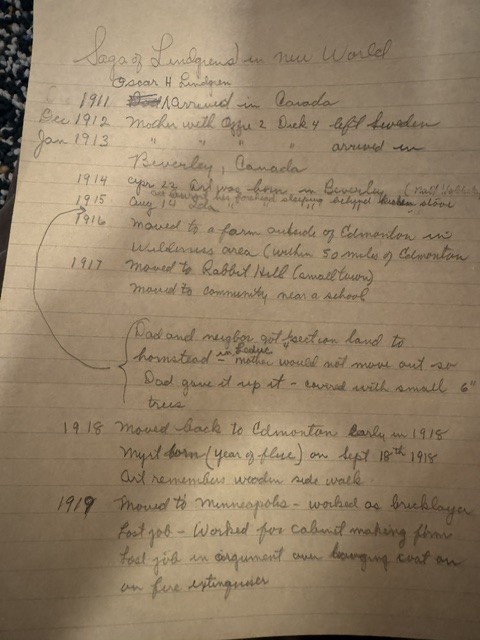
Saga of Lindgrens in New World
Oscar H. Lindgren
- 1911 Arrived in Canada
- Dec 1912 Mother with Ozzie 2, Dick 4 left Sweden
- Jan 1913 Mother with Ozzie 2, Dick 4 arrived in Beverley, Canada
- 1914 Apr 22 Art was born in Beverley ([illegible])
Art [burned?] his forehead sleeping [against?] kitchen stove - 1915 Aug 14 Ida was born in Beverley
- 1916 Moved to a farm outside of Edmonton in wilderness area (within 50 miles of Edmonton)
Dad and neighbor got ¼ section land to homestead in Leduc — mother would not move out so Dad gave it up — it covered with small 6″ trees - 1917 Moved to Rabbit Hill (small town)
Moved to community near a school - 1918 Moved back to Edmonton early in 1918
Myrt born (year of flue) on Sept 18th 1918
Art remembers wooden side walk - 1919 Moved to Minneapolis — worked as bricklayer
Lost job — worked for cabinet making firm
Lost job in argument over hanging coat on fire extinguisher
Page two: the farms, Pipestone, and Kenosha
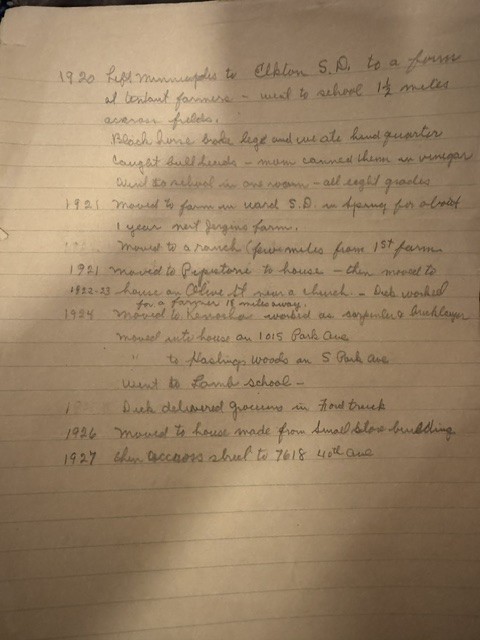
- 1920 Left Minneapolis to Elkton S.D. to a farm as tenant farmers — went to school 1½ miles across fields.
Black horse broke leg and we ate hind quarter
Caught bullheads — mom canned them in vinegar
Went to school in one room — all eight grades - 1921 Moved to farm in Ward S.D. in spring for about 1 year, next Jergins farm.
Moved to a ranch (few miles from 1st farm) - 1921 Moved to Pipestone to house — then moved to
- 1922–23 house on Olive St near a church. — Dick worked for a farmer 18 miles away.
- 1924 Moved to Kenosha, worked as carpenter & bricklayer
Moved into house on 1015 Park Ave
Moved to Hastings Woods on S. Park Ave
Went to Lamb school —
Dick delivered groceries in Ford truck - 1926 Moved to house made from small store building
- 1927 then across street to 7618 40th Ave
Reading between the lines
Short as they are, these notes fill in details that appear nowhere else. They give exact birthdays for the three children born in Canada: Art on April 22, 1914, Ida on August 14, 1915, and Myrtle on September 18, 1918, “the year of flue.” They name the places the family farmed after leaving Minneapolis — Elkton and Ward, in South Dakota, and the Jergins farm — and they follow the family through three addresses in Kenosha.
They also add a few stories the memoir doesn’t tell. Oskar once had a chance at a quarter section of homestead land near Leduc, south of Edmonton, but it was covered in young trees, and Ida flatly refused to move out to it, so he gave it up. And in Minneapolis, Oskar’s job with the cabinet-making firm ended over something as small as an argument about hanging his coat on the fire extinguisher. Dick’s memoir says his father “had quick temper and was not bashful if he thought he was not being treated fairly”; here is the proof.
Where the saga and other records differ
- Ida’s sailing. The saga has Ida and the boys leaving Sweden in December 1912 and reaching Beverly in January 1913. The Malmö emigration register gives November 26, 1912, as the departure date. Both fit a winter crossing to Portland, Maine, as told in Coming to Canada.
- Art’s birth year. The saga gives April 22, 1914. That matches the 1919 border record, which lists him as five years old (as “Nels”; see Coming to America).
- Ida’s birthplace. The saga says Ida was born in Beverly in August 1915. In the memoir Dick remembered her birth during the summer on the Rabbit Hill farm. The 1919 border record lists her birthplace as Beverly, and gives her age as four.
- When they left Minneapolis. The saga dates the move to Elkton to 1920. In the memoir Dick placed it in 1921, during that year’s recession.
- Elkton. The memoir describes Elkton as being in western Minnesota near the South Dakota line. The saga places it in South Dakota. Elkton, South Dakota, sits right on the state line, about fifteen miles from Flandreau, just as Dick described.
Sources
- Richard H. Lindgren, “Saga of Lindgrens in New World,” two handwritten pages, undated.
- Richard H. Lindgren, Early Memories of Richard Hakvin Lindgren (see Uncle Dick’s Memoir).
- U.S. border-crossing manifest, Port of Noyes, Minnesota, May 24, 1919.