How this story was pieced together
This chapter draws on what Uncle Dick remembered and what his mother told him, on Swedish church records traced by a researcher in Malmö during a family visit, and on the history of Malmö itself. Dick left Sweden at four, so much of what he knew came from his parents — and, as he wrote, they rarely talked about their early lives.Malmö sits at the very southern tip of Sweden, looking across a narrow strait of water, the Öresund, toward Copenhagen. Around the turn of the twentieth century it was one of the fastest-growing places in the country. Factories making textiles, tobacco, rubber, chocolate and machinery drew people in from the farms of Skåne and beyond, and by 1910 more than half of the city’s working men were employed in industry. Malmö was already Sweden’s third-largest city — a position, Dick noted proudly, “it still holds today.”
This is where Oskar Lindgren and Ida Malmberg grew up, met, married, and started a family — and where, in 1911 and 1912, they made the decision to leave it all behind.
Two families
The Lindgrens were craftsmen. Oskar’s father, Per Håkansson Lindgren, was born on August 23, 1847, in Sundstorp, in what is today Kungsbacka municipality, just south of Gothenburg on Sweden’s west coast. (His middle name means “son of Håkan” — which is very likely where Oskar’s own middle name, Haqvin, came from.) His wife, Johanna Månsdotter, was born on February 12, 1856, in Fränninge, in today’s Sjöbo municipality in Skåne.
When Oskar was born in 1883, the church record lists Per as a timmerman — a carpenter — living in the Trasten block of Malmö. Over the years he became a master carpenter, and by Dick’s time the family ran a cabinet-making business where the sons worked. Malmö’s birth records name Oskar’s brothers and sisters: Emma (1879), Albin Sigfrid (1880), Emmy Hildina (1886), Dagma Altea (1889) and Gotvi Arthur Napoleon (1892). Oskar was the fifth child.
They were an athletic bunch. Dick wrote that his father and uncles were “very active in athletics, field sports such as running, high jumping, pole vaulting, and in wrestling” — and that the youngest Lindgren brother — most likely Gotvi — went on to become Sweden’s amateur wrestling champion in the middleweight class.
The Malmbergs were working people of a different sort. Ida’s father, Nils Malmberg, was born on March 13, 1860, in Lockarp parish, just outside Malmö. Her mother, Ida Håkansson, was born on April 21, 1866, in Asarum, in the province of Blekinge to the east. When Ida was born, the church record lists Nils as an arbetare — a laborer — living in the Hinden block. Dick’s mother described him as a teamster, part of a group of freight haulers who moved goods around the city by horse and wagon. According to Ida, her father’s team of horses “were the apple of her father’s eye.” Ida was the eldest of nine children; two died shortly after they were born.
The two families did not see each other as equals. Dick’s mother told him that the Lindgrens “looked down on the Malmbergs,” believing themselves to be of a higher social class, and this caused real trouble when Oskar and Ida decided to marry. But the Malmberg household had something the Lindgrens seemed to lack. “My mother’s family seemed more cheerful, and they laughed a lot,” Dick remembered. “Mother’s father was a happy man and was loved by my grandmother and the children.”
Oskar, the rebel
Oskar Haqvin Lindgren was born on December 15, 1883, and baptized in Malmö’s Caroli parish. He trained first as a carpenter, following his father, and reached the rank of journeyman. Records also show him serving in the Swedish navy in 1902, when he was only eighteen — two years before he would have been called up as a conscript, which suggests he may have volunteered. Then he struck out on his own path. He apprenticed as a bricklayer and mason — work he would love all his life. “I believe he was a rebel on his family tree,” Dick wrote.
The rebellion went beyond his choice of trade. Oskar belonged to the Socialist Party at a time when Sweden’s labor movement was growing fast, while the rest of his family leaned conservative. Malmö was at the center of that movement: the Swedish masons’ union was born there in 1882, and so was the Social Democratic Youth League in 1903, whose leader Zeth Höglund was jailed in Malmö in 1905 for a manifesto titled Ned med vapnen! — “Down with weapons!” — urging soldiers not to fight Norway. (The Social Democratic party itself was not pacifist; it favored a citizens’ militia. Oskar’s pacifism was his own.) He was quick-tempered and proud. He was also a man who loved to sing. He belonged to a glee club, and his wife later told a story about one of their practice nights:
“They would complete the verse from a song and start down the street but only for another 100 feet when they stopped and sing again.” — Dick, retelling his mother’s story
Oskar was late coming home that evening, so Ida and her sister went out looking for him. They found him and his friends, a little worse for a stop at a bar after rehearsal, weaving slowly homeward and stopping every hundred feet or so to sing another verse. The two women walked along on the opposite side of the street, a couple of policemen watched with amusement, and eventually Oskar was safely put to bed.
Ida, the city girl
Ida Natalia Malmberg was born in 1887 in Malmö’s S:t Pauli parish, the first child of Nils and Ida. The family remembers her birthday as May 10, though the official index of Malmö births reads October 5 — perhaps a date written “10/5” and read two different ways. She was small — about five foot three and 110 pounds — and a true city girl. Both she and Oskar loved to ice skate, and whenever the ponds froze, they were out on them. Southern Sweden’s winters are mild for a place so far north, and Ida told Dick there were some years with hardly any ice to skate on at all.
Oskar and Ida were married on April 8, 1907. She was nineteen and he was twenty-three.
Home in Möllevången
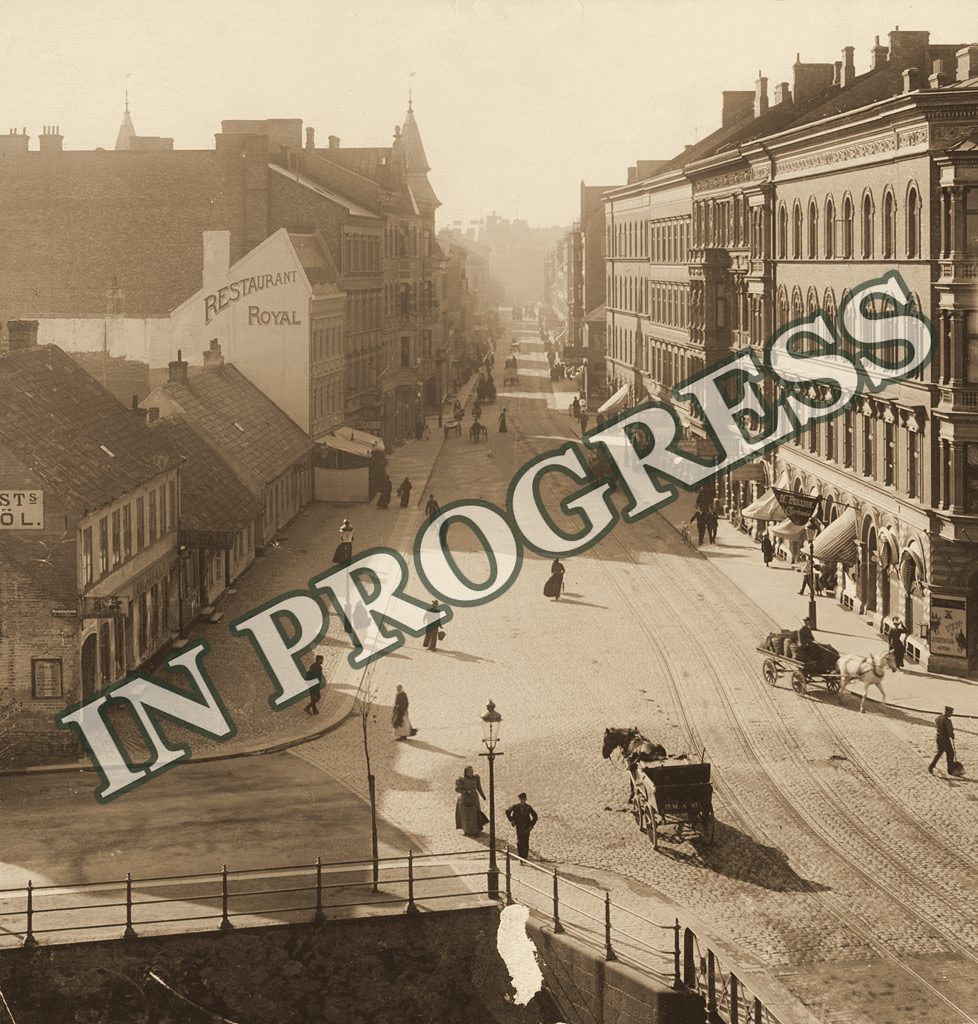
Malmö’s old records name city blocks rather than street addresses. Oskar grew up in a handful of them: his sister Emmy was born in the Laxen block in 1886, and his brother Gotvi in the Kråkan block in 1892. The researcher’s notes also place the family in the Blenda and Vessin blocks. All of them lie along Södra Förstadsgatan, a long street running south from the old city center into the area now called Möllevången.
Möllevången was Malmö’s great working-class district. It was laid out in the early 1900s to house the families pouring in to work in the factories, and it is remembered as the cradle of Malmö’s labor movement. Sweden’s first Folkets Park — a “People’s Park” for workers’ gatherings, dances and speeches — was here. For a young socialist bricklayer, it was home in every sense.
Just before they left for Canada, Oskar and Ida were living back in the Laxen block, where Oskar had spent part of his childhood, in central Malmö between Södra Förstadsgatan, Brogatan and Kasinogatan. Many of the old buildings there have since been torn down, but a few from that era still stand at Södra Förstadsgatan 36–38. When family members visited Malmö years later, this was the neighborhood they walked through.
Two little boys
Rickard (Richard) Haqvin Lindgren — our Uncle Dick — was born on May 17, 1908, and baptized three days later. His brother Yngve Oscar Lindgren followed on February 22, 1910, recorded in S:t Johannes parish. The boys’ arrival didn’t heal the rift between the families, but both sets of grandparents, aunts and uncles would soon have their hands full with them.
The year apart
In 1908 Malmö’s building trade had all but stopped, and in 1909 the Great Strike failed; work for a bricklayer was scarce. Oskar’s politics, too, put him at odds with the direction Europe seemed to be heading. In June 1911 he left for Canada alone, promising to send for his family as soon as he could. (His journey is told in Story Two: Coming to Canada.)
For the next year and a half, the family was split. Dick, three years old, went to stay with his Lindgren grandparents in a large apartment building where each floor housed about eight families who took turns at a shared toilet and bath. He remembered dark furniture and a household where “no one laughed very much.” His uncles and aunts quarreled a great deal, he wrote, “however, they all seemed to love and take care of me.” Once his grandmother cooked him a special dinner because he didn’t like what was being served — and got scolded for it by one of his uncles.
Little Oscar stayed with Ida at the Malmberg home across town. Ida went to work in a chocolate factory to support them. We don’t know which one, but the best-known was Mazetti, on Bergsgatan at the edge of Möllevången. Its old factory building still stands today as a cultural center. Before long, Ida rented a flat above a shop near the harbor, and the boys spent their days with their grandparents.
Finally, in the autumn of 1912, the letter came: Oskar had work and a house. Early one morning in late November, Ida’s family and the kindly shopkeeper from downstairs walked them to the ship. The shopkeeper gave the boys a bag of candy. Then Ida, twenty-five years old, took her two small sons and set out for the other side of the world.
Never going back
Oskar and Ida never saw Sweden again. They became American citizens in the 1920s, and Oskar died in 1938. But their children kept the connection alive. After the Second World War, Dick, his brother Art and his sister Ida visited Sweden together. In the summer of 1965, Dick flew into Stockholm, drove through the country, and stayed with a cousin who still lived in Malmö. He found it “a neat, beautiful country” where “no one appeared poor and only a few seemed relatively rich.”
Years later, Oscar’s son Scott made the journey too, hiring a local guide and researcher, Michael T. Pedersen, to trace the family through Malmö’s church records and walk the old neighborhoods. Much of what we know about Per and Johanna, Nils and Ida, and the streets where the family lived comes from that trip.
“I have always been proud to claim Sweden as the place where I was born and the United States where my family and I became citizens.” — Richard Lindgren
Timeline
- 1847 Per Håkansson Lindgren born in Sundstorp, near Kungsbacka.
- 1856 Johanna Månsdotter born in Fränninge, Skåne.
- 1860 Nils Malmberg born in Lockarp parish.
- 1866 Ida Håkansson born in Asarum, Blekinge.
- Dec 15, 1883 Oskar Haqvin Lindgren born in Malmö.
- 1887 Ida Natalia Malmberg born in Malmö.
- 1892 Gotvi, the youngest Lindgren brother, born in the Kråkan block.
- 1902 Oskar, age 18, serves in the Swedish navy.
- Apr 8, 1907 Oskar and Ida marry.
- May 17, 1908 Richard (Dick) born.
- 1909 The Great Strike shakes Sweden.
- Feb 22, 1910 Yngve Oscar born.
- June 6, 1911 Oskar emigrates to Canada.
- Nov 26, 1912 Ida and the boys leave Malmö to join him.
A note on the records
- The researcher’s notes give Oskar’s birth parish as “Cartoll” and Nils Malmberg’s as “Lockaer.” These are most likely Caroli parish in Malmö and Lockarp parish just outside the city.
- The family spelled the middle name several ways: Hakvin in Dick’s memoir, Haqvin in the Swedish records.
- We don’t know for certain which chocolate factory Ida worked in. Mazetti is only a likely guess.
- Ida’s birth date: the family says May 10, 1887; the Malmö birth index says October 5, 1887. The original church book (S:t Pauli C I:2a, page 179) would settle it.
- Dick remembered four boys and three girls in his father’s family; the birth index so far shows two other boys and three girls besides Oskar. Some children may have been born in other parishes or years not yet searched.
Sources
- Richard H. Lindgren, Early Memories of Richard Hakvin Lindgren, Chapter One and “Malmo Sweden” (see Uncle Dick’s Memoir).
- Research notes by Michael T. Pedersen, Malmö, drawn from Swedish parish registers and the Malmö police emigration lists.
- Malmö city archive birth index, Riksarkivet: Oskar Haqvin, 1883 and Ida Nathalia, 1887, plus entries for Oskar’s siblings.
- Histories of Möllevången, Malmö’s industrial growth, and the Mazetti chocolate factory.
- Histories of the 1909 Swedish general strike and Swedish emigration.