How this story was pieced together
This is the family’s best understanding of how and why the Lindgrens came to Canada. It draws on Uncle Dick’s memories, on original Swedish and Canadian records (quoted in the boxes below), and on the history of the places they passed through. Where we are making an educated guess, we say so.In the autumn of 1912, a young mother named Ida Lindgren stood on the dock in Malmö, Sweden, with her two little boys — Richard, who was four, and Oscar, who was two. Her family and the shopkeeper from downstairs had come to see them off; the shopkeeper pressed a bag of candy into the boys’ hands. Ida spoke no English. She had never been more than fifty miles from home. Ahead of her lay roughly seven thousand miles of sea and railway, and at the far end, on the edge of the Canadian prairie, her husband Oskar was waiting.
This is the story of how they got there, why they went, and the seven hard, adventurous years the family spent in Alberta before moving on to the United States.
Malmö, 1908–1911: hard times
Uncle Dick wrote that neither of his parents would ever talk about why they left. But the records of the time tell us a great deal about the world Oskar Lindgren, a 27-year-old bricklayer, was living in.
There was almost no building work. In the autumn of 1908, a Swedish government report on unemployment quoted the building employers themselves: in Gothenburg and Malmö, they said, construction had “practically come to a standstill.” Some 1,700 to 1,800 people in Malmö were out of work. For a man who laid bricks for a living, with a wife and a baby born that May, this was serious.
Malmö was a city in turmoil. That July, during a bitter dock strike, three young socialists set off a bomb aboard the Amalthea, a ship in Malmö harbor housing strikebreakers brought over from England. One man was killed and twenty-three were injured. The Social Democratic leaders condemned the attack, but it shook the whole city and remains one of the most-written-about events in Swedish labor history.
Then came the Great Strike. In August 1909, some 300,000 Swedish workers walked out in the general strike known as Storstrejken — and the masons’ union was among them. After a month the strike collapsed. Employers let about 20,000 workers go, many strikers were never rehired, and union membership across Sweden fell by nearly half. Uncle Dick remembered it simply: “There also had been a general strike in Sweden and very little work if any for anyone.”
Malmö was the heart of all this. The Swedish masons’ union had been founded there; so had the antimilitarist Social Democratic Youth League. The city’s Folkets Park and its labor newspaper Arbetet were gathering places for working people. Oskar, a socialist who lived in the working-class district of Möllevången, could hardly have been untouched by any of it.
Why did Oskar leave? Weighing the reasons
Most people who leave home have more than one reason. Here are the five most likely explanations, with an honest label for how strong the evidence is.
1. Work and a better living Strongly supported
Malmö’s building trade had collapsed, the strike had failed, and work was scarce. Meanwhile Edmonton, the capital of the new province of Alberta, was booming — from about 25,000 people in 1911 to more than 70,000 by 1914. Big stone and brick projects were underway, including the Alberta Legislature (opened 1912) and the Hotel Macdonald (begun about 1911). Dick wrote that the city’s growth “attracted my father, particularly because he could earn a living for his family as a mason.”
2. A planned family move Documented
The records show exactly the pattern Dick described: Oskar went first in June 1911, found work, bought a lot, built a house — and seventeen months later Ida and the boys left Malmö with Edmonton written as their destination. This was the common way to do it. At the height of Swedish emigration, nearly half of all emigrants travelled on tickets bought for them by someone who had gone ahead.
3. Pacifism and military duty Possible, unproven
Dick believed his father’s pacifism helped drive him out of Europe. There is real context for this. Under Sweden’s 1901 conscription law, a man Oskar’s age remained liable to be called up in wartime until he was forty; a conscript even needed the King’s permission to emigrate. There was no legal alternative for conscientious objectors before 1920 — those who refused to serve were jailed again and again. In 1909, a member of the Swedish Parliament noted that for such men the “only way out” was to emigrate, and that several had gone to America.
But there are good reasons for caution. Oskar had served — Swedish records show him in the navy in 1902, at just eighteen, which suggests he may even have volunteered. The Social Democratic party itself was not pacifist. And Dick’s link to the First World War comes with hindsight; the war was still three years away, and Canada, as part of the British Empire, would go to war in 1914 too. A record of Oskar’s permission to emigrate (or of his leaving without it) could help settle the question.
4. A break with his family’s world Partly supported
Dick wrote that his father’s family considered themselves a cut above Ida’s, that they leaned conservative while Oskar was a socialist, and that Oskar was “a rebel on his family tree” for choosing bricklaying over the family cabinet business. Leaving the country put an ocean between him and those tensions. Still, we should be careful: in 1883 Oskar’s father was recorded simply as a carpenter, so the family business may have been a modest workshop rather than a large factory, and Oskar trained first in his father’s trade. Choosing masonry may have been as much about wages as about rebellion.
5. All of the above Most likely
The most believable picture is a combination: a skilled tradesman with a young family, out of work in a city where his trade had collapsed, with politics and family friction making it easier to go, and a booming Canadian city offering exactly the kind of work he loved. As Dick put it, “He loved his work.”
Oskar goes ahead — June 1911
On June 6, 1911, Oskar’s name was entered in the Malmö police register of emigrants:
Murare Oscar H Lindgren, 27, S:t Pauli, Malmö — Quebec — 140.00Bricklayer Oscar H. Lindgren, age 27, of S:t Pauli parish, Malmö. Destination: Quebec. Fare: 140 kronor. Ships: Cedric & Laurentic, White Star Line, travelling via Esbjerg, Denmark.
The register names two White Star ships, the Cedric and the Laurentic. Since the Cedric sailed to New York while the Laurentic ran to Quebec and Montreal, Oskar almost certainly crossed on the Laurentic. The record also shows his route: from Malmö to the Danish port of Esbjerg, across the North Sea to England, by train to Liverpool, and then aboard the ocean liner.
On the very next line of the register is another Malmö man bound for Quebec on the same ticket series: Snickare Nils Landgren (or Lindgren), a 32-year-old carpenter. We don’t know who he was — a friend, a workmate, perhaps even a relative — but it seems Oskar did not make the journey entirely alone.
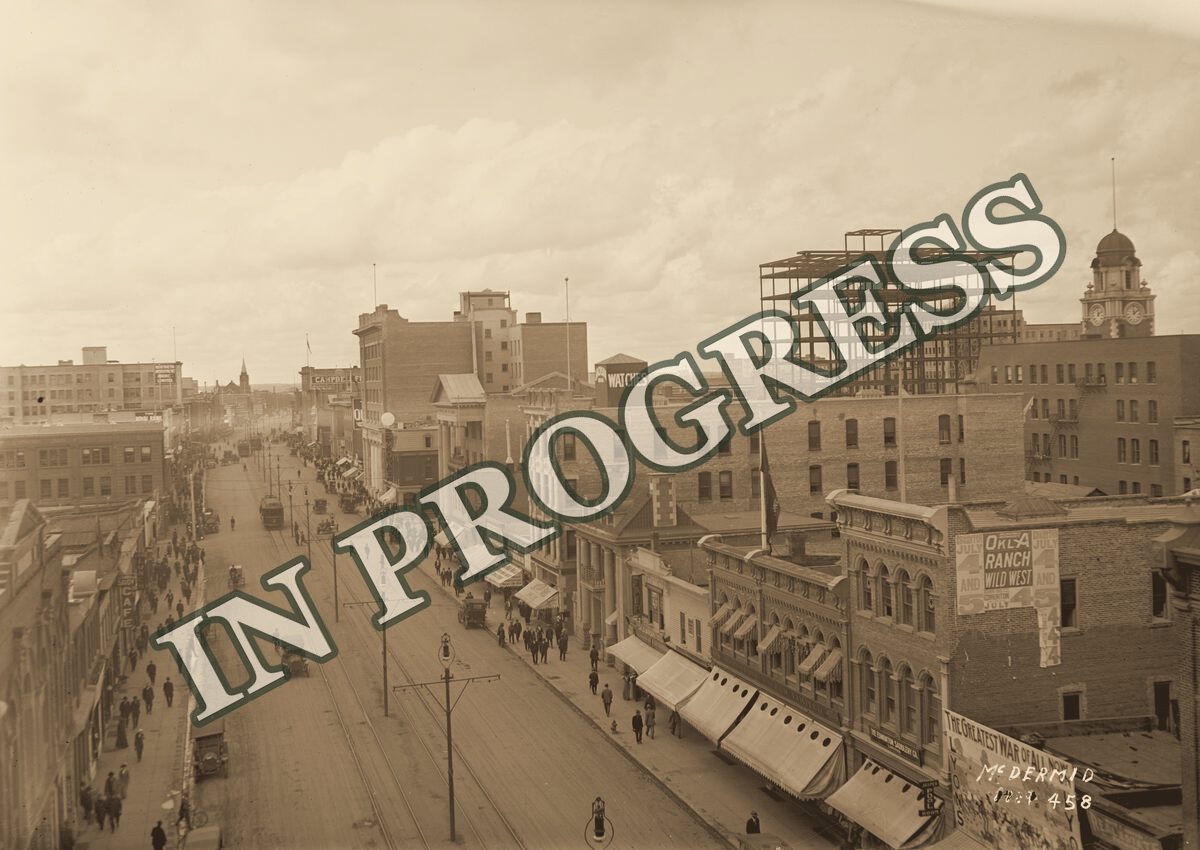
Canada welcomed Scandinavians as some of its most desirable immigrants, though its recruiting was mostly aimed at farmers. Each new arrival had to show at least $25. From Quebec, Oskar travelled west to Winnipeg and then on to Edmonton, where he found work, bought a lot in Beverly, and began building a house with friends from work. Only when he had a job and a roof could he send for his family.
“I concluded that my mother was one of the bravest persons I have ever known.” — Richard Lindgren
Ida’s crossing — November 1912
Fru Ida N Lindgren, 25, S:t Pauli, Malmö — Edmonton. Barn: Rickard H., 4; Yngve O., 2Mrs. Ida N. Lindgren, age 25, with children Rickard H., 4, and Yngve O., 2. Destination: Edmonton. Ship: Teutonic, White Star Line, to Portland, Maine, via Esbjerg.
Dick’s memories of the trip fit the record closely. He remembered a ship of the “North Star Lines” — surely the White Star Line, named right there in the register. The Teutonic had once been one of the fastest liners on the Atlantic, but by 1912 she had been refitted to carry emigrants on the Canadian run. In winter, when the St. Lawrence River froze, that route ended at Portland, Maine — exactly where Dick remembered coming ashore.
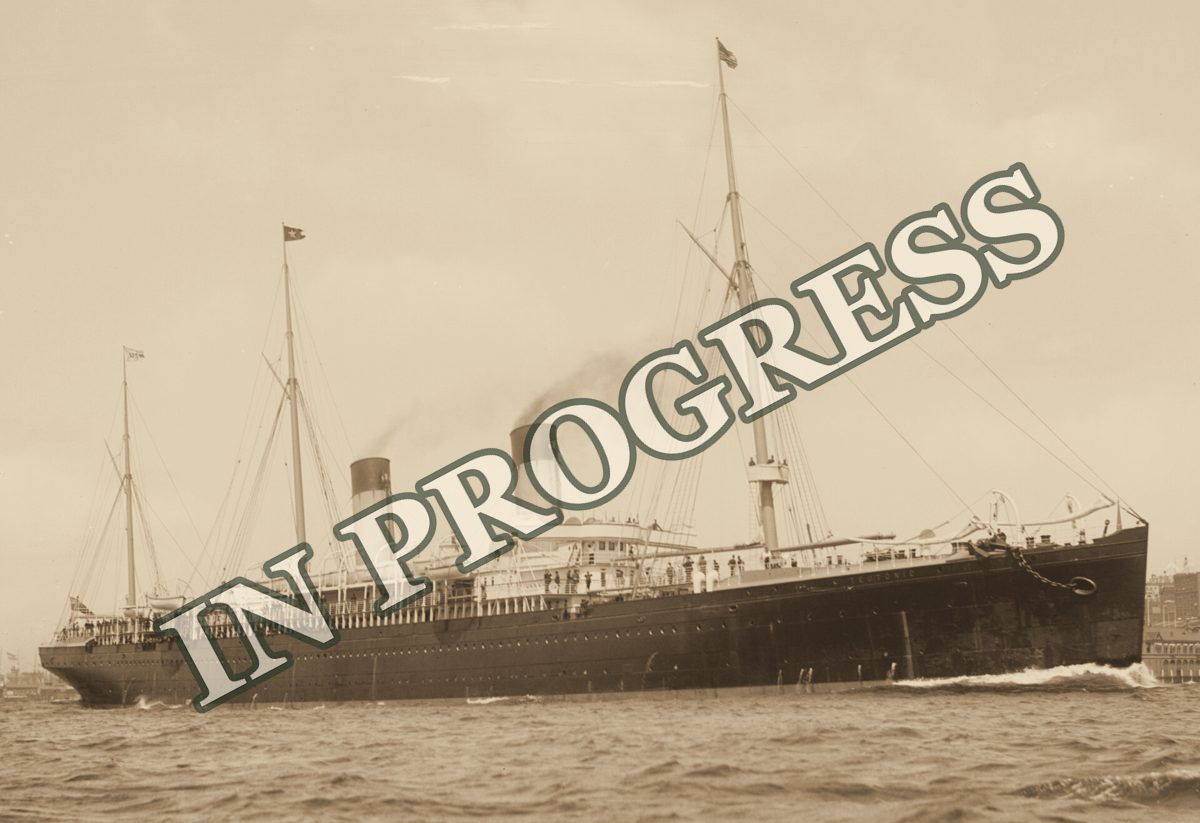
The “small freighter” Dick also remembered was most likely the first leg: the North Sea crossing from Esbjerg to England. He wrote that the first days were pleasant, but “on the third day we reached the North Sea and the Atlantic Ocean, and the sailing was rough.” Families were packed into converted holds. Nearly everyone was seasick, the smell was overwhelming, and a few passengers died and were buried at sea. They reached North America in the middle of December 1912.
Two thousand miles by train
From Portland, the family boarded a train north into Canada (Dick remembered going to Quebec), and then faced more than a week of travel west. They sat up in their seats by day and slept in them at night. At each stop, Ida hurried to the nearest store to buy food, which was cheaper than meals on the train — all without speaking a word of English.
At one station, while the locomotive took on coal, the three of them wandered through town and climbed back aboard the wrong train. They were heading north instead of west before the conductor noticed, put them off at the next station, and sent them back to try again.
Ida had written Oskar with their expected schedule, but no one could say exactly when they would arrive. So for at least a week, Oskar went to the Edmonton station every day to meet the trains. They finally stepped off, tired but happy, on a cold day late in December 1912.
Beverly
Lindgren Oscar brklyr h e s 45th St nr 121st Ave (Beverly)Oscar Lindgren, bricklayer; house on the east side of 45th Street near 121st Avenue, Beverly. The same listing appears in 1915 and 1916.
The house Oskar built stood on the east side of 45th Street (earlier called Clare Street) near 121st Avenue, in the old town of Beverly — now part of northeast Edmonton. Street names and numbers have changed over the years, so the exact spot today still needs checking. Beverly was a coal town. The richest seam in the Edmonton area ran beneath it, and more than twenty mines worked the banks of the North Saskatchewan River. A few months after the Lindgrens arrived, in March 1913, Beverly was officially organized as a village; by 1914 it was a town of about a thousand people, many of them immigrants from England, Scotland, Germany, Holland and Ukraine.
The house was enclosed but unfinished: two rooms, one for cooking, eating and living, the other split between Oskar and Ida’s bed and a pair of bunks for the boys. Oskar built the table, the benches, and the bunks himself. There was a well and pump in the yard, a shed for wood and coal dug from the riverbanks, and an outhouse. The nearest house was two blocks away. On the coldest mornings, Dick remembered, you could hear the boards of the wooden sidewalks snap when someone walked on them.
Ida, a city girl, was frightened of the cows tethered along the road. She couldn’t speak to her neighbors until a newly married Norwegian couple built a house nearby; Swedish and Norwegian are close enough that at last she had someone to talk to. In 1915, Oskar read about raising Leghorn hens and built a brooder in the fuel shed. He stayed up through the night when the chicks were hatching. Dick wrote that the eggs “didn’t help a great deal towards our living requirements, but they kept us from starving.”
There were good moments too. Oskar, an athlete since his youth in Malmö, entered the field games in Edmonton and won first prize in the pole vault. Dick remembered how proud he was of that cup.
Boom, bust, and war
The good times did not last. Edmonton’s land boom collapsed in 1913, and in August 1914 Canada — as part of the British Empire — went to war. Building stopped almost overnight. Edmonton’s population fell by a quarter in two years as men enlisted and work dried up.
Oskar took whatever work he could find, including in the coal mines along the river. As a citizen of neutral Sweden and a pacifist with a quick temper, he clashed with English and Scottish neighbors who strongly supported the war. Dick remembered his father coming home some nights with black eyes and a bloody nose.
Around this time, Dick got his first job. In his memoir he placed it in the winter of 1914–15, when he was “seven years old” — but since his brother was born in April 1914, it was more likely the winter of 1913–14, when Dick was five. The Norwegian neighbors had gone to cook and keep house at a lumber camp near Leduc, south of Edmonton, and they needed someone to mind their baby. Dick rode the train alone, was dropped at a tiny shack in the middle of nowhere, and waited for hours until a sled pulled by two oxen came out of the woods to fetch him. When he came home in the spring, he had a new baby brother, Arthur, born in Beverly on April 22, 1914 — the first of the family born outside Sweden. Before long the house was gone too: Oskar could no longer make the payments, and the family had moved to a rented house.
The farming years
With no building work to be had, Oskar turned to farming as a tenant, working other men’s land in exchange for a share of the crop. Ida, who had once been afraid of cows, learned to milk them twice a day. The boys rode an old horse four miles to a one-room school.
In the spring of 1916 they moved to a farm near Rabbit Hill, southwest of Edmonton, owned by a Mr. King, who became Oskar’s friend and taught him a great deal about farming. Dick remembered it as “a happy year for us all. One of the very few since we had come to Canada.” Their sow’s litter of ten piglets won a prize at the fair, and Dick’s name and picture appeared in the paper. In the evenings, coyotes gathered at the edge of the fields and howled, and the family sat and listened to the chorus. That summer, Dick’s sister Ida was born — the first girl in the family.
When Mr. King sold the farm that fall, the family moved again, to a two-story house in a more settled area. Oskar found work far away and came home only once or twice a month. When the woodpile ran dangerously low one winter, the neighbors turned up one weekend with a saw, cut down trees, split the wood, and accepted nothing but coffee and Ida’s heartfelt thanks.
Leaving Canada — 1918–1919
In 1918, Oskar found work in Edmonton again and the family moved back to the city. A new baby, Myrtle, joined them. That autumn the Spanish flu reached Alberta; officially more than 38,000 Albertans fell ill and over 4,300 died. Every member of the Lindgren family caught it — including baby Myrtle — and every one of them survived. In November the war ended, and Canada celebrated.
Canada had brought in conscription in 1917, but the law applied only to British subjects. As a Swedish citizen, Oskar was not liable to be drafted — so the war itself probably wasn’t what drove the family out. More likely it was work again. That winter, through a contact in Minneapolis, Oskar found a contractor who needed bricklayers, and he left for Minnesota in the spring of 1919. Later that summer, Ida once again gathered up her children — five of them now — and travelled by train east to Winnipeg, then south through International Falls to Minneapolis, where Oskar was waiting.
Dick summed it up simply: “She was a remarkable woman, our mother.”
Timeline
- 1908 Malmö’s building trade collapses; the Amalthea bombing in Malmö harbor. Richard is born in May.
- 1909 Sweden’s Great Strike; the masons’ union joins. Thousands lose their jobs.
- 1910 Yngve Oscar is born in February.
- June 6, 1911 Oskar leaves Malmö via Esbjerg for Quebec, then heads west to Edmonton.
- Nov 26, 1912 Ida, Richard (4) and Oscar (2) leave Malmö, bound for Edmonton on the Teutonic.
- Dec 1912 They land at Portland, Maine, cross Canada by train, and join Oskar in Beverly.
- Winter 1913–14 Dick spends the winter minding a baby at a lumber camp near Leduc.
- Apr 22, 1914 Arthur is born in Beverly.
- 1914 War begins and building stops. Oskar is listed as a bricklayer on 45th Street, Beverly.
- 1915 The house is lost; tenant farming begins.
- 1916 The happy year at Mr. King’s farm near Rabbit Hill. Ida is born.
- 1918 Back to Edmonton. Myrtle is born. The whole family survives the Spanish flu.
- 1919 Oskar leaves for Minneapolis in spring; Ida follows with all five children that summer.
When family accounts differ
Some family retellings say three children were born in Sweden and four in Canada. The Swedish records and Uncle Dick’s memoir agree on two born in Sweden (Richard and Oscar) and three in Canada (Arthur, Ida and Myrtle) — five in all. The family also didn’t stay in Edmonton: after 1919 they lived in Minnesota, then settled for good in Kenosha, Wisconsin, in 1924.Questions still open
- Did Oskar have the King’s permission to emigrate? As a conscript he needed it. Malmö parish records may say.
- What was his navy service in 1902? He was only 18 — too young to be conscripted — so he may have volunteered. Swedish military archives (Krigsarkivet) should have his enrollment.
- Who was Nils Landgren, the carpenter who left with him?
- The ship’s passenger lists. Canadian passenger lists for the Laurentic (Quebec, June 1911) and the Teutonic (Portland, December 1912) should show the family.
- The 1916 census. Canada took a special census of the prairie provinces in 1916. The family should appear in it, possibly near Rabbit Hill, confirming the children’s birthdates.
- The 1919 border crossing. U.S. records of Ida and five children entering at International Falls may survive.
Sources
- Richard H. Lindgren, Early Memories of Richard Hakvin Lindgren, Chapters One and Two (see Uncle Dick’s Memoir).
- Malmö police emigration registers (Poliskammaren i Malmö, Utvandrarlistor), Riksarkivet: 6 June 1911 (Oskar) and 26 November 1912 (Ida and the boys).
- Henderson’s Edmonton City Directory, 1914–1916 (Peel’s Prairie Provinces, University of Alberta, via archive.org).
- Research notes by Michael T. Pedersen, Malmö, from Swedish parish registers.
- Kommerskollegium, Arbetsstatistik A:6, memorandum on unemployment in Sweden, autumn 1908.
- Swedish Riksdag, motion AK 1909:180 on conscientious objectors; Royal proposition 1909:183.
- Histories of the Amalthea affair (City of Malmö), the 1909 general strike, and the Swedish masons’ union.
- City of Edmonton Archives and the Edmonton Historical Board; Provincial Archives of Alberta (the Legislature Building).
- Canadian Encyclopedia and Pier 21 (immigration policy, 1910 Immigration Act, Military Service Act 1917).
- Histories of the RMS Teutonic, SS Laurentic and RMS Cedric.
- Alberta Doctors’ Digest, “The 1918–19 Spanish Flu in Alberta.”